
Siobhan O'Malley
Editorial byline
Siobhan O'Malley is an editorial byline for Boardroom Digest, with a focus on C-Suite Leadership, Executive Appointments. Biographical credentials and external profiles are published only after verification.
Learn more about our editorial process and use of automation in our AI & Automation disclosure.
Coverage Areas
Latest Articles

Five Considerations for Boards Appointing Independent Directors with Emerging Technology Expertise
Boards recruiting independent directors for emerging technology oversight must prioritize strategic foresight and business consequence analysis over operational fluency. This involves evaluating candidates on their capacity for constructive challenge, risk acumen, and ability to translate technological shifts into long-term strategy.
Oct 31, 2026 · 5 min read

Four Competencies That Separate a Strategic CSO From a Compliance Manager
The Chief Sustainability Officer role has transformed from compliance and reporting to strategic enterprise transformation. Boards must evaluate candidates on four core competencies: strategic integration, operational execution, stakeholder engagement, and transformational leadership, to ensure they hire a strategic leader.
Oct 30, 2026 · 4 min read

Before You Create That New C-Suite Role: A Four-Question Framework for Boards
Boards must use a four-question framework to strategically evaluate the necessity and integration of new C-suite roles, such as Chief AI Officer, to avoid creating silos and ensure enterprise capability. This structured approach helps decide between a dedicated specialist or embedding responsibilities into existing executive remits.
Oct 29, 2026 · 5 min read

Centralized, Decentralized, or Federated: How C-Suite Leaders Should Choose Their Data Governance Model — and Who Should Lead It
C-suite leaders must choose a data governance operating model (centralized, decentralized, or federated) that aligns with their organization's structure, maturity, and regulatory needs. The article also maps key executive roles and accountability structures essential for successful implementation.
Oct 28, 2026 · 4 min read

From Pilot Purgatory to Enterprise Scale: A C-Suite Roadmap for AI That Delivers
Enterprise AI success requires a structured roadmap to move beyond pilot purgatory and achieve company-wide scale. This C-suite guide outlines assessing readiness, building foundational blocks, and implementing a pilot-to-scale decision framework for measurable business value.
Oct 28, 2026 · 5 min read

Appointing a Non-Executive Chairperson: Five Factors That Should Drive the Board's Decision
Appointing a non-executive chairperson is a critical governance decision requiring a structured evaluation beyond impressive CVs. Five key factors—independence, leadership style, CEO relationship management, strategic skills, and personal qualities—should drive the board's choice to ensure effective oversight and strategic success.
Oct 27, 2026 · 6 min read

Five Competencies That Separate AI-First C-Suite Leaders From the Rest
Successful AI-first C-suite leaders require a blend of traditional strategic strength with five key competencies: strategic vision, critical evaluation, resilience, human-machine collaboration, and ethical communication. These skills are essential for navigating the evolving AI landscape and driving organizational success.
Oct 26, 2026 · 5 min read

How Boards Can Assess and Onboard Non-Executive Directors with Real AI Governance Expertise
Boards often mistakenly add "technology" expertise to their skills matrix, overlooking the need for directors with judgment across AI governance domains. This article presents a diagnostic framework for assessing AI governance competencies and a checklist for integrating new directors effectively.
Oct 26, 2026 · 6 min read

Four Ways to Link ESG to Executive Pay—and the Trade-Offs Each One Carries
Linking ESG metrics to executive pay involves four structural choices: short-term vs. long-term incentives and quantitative vs. qualitative measurement. Each approach presents distinct trade-offs in rigor, transparency, and strategic alignment, requiring careful design based on company priorities and data.
Oct 26, 2026 · 5 min read
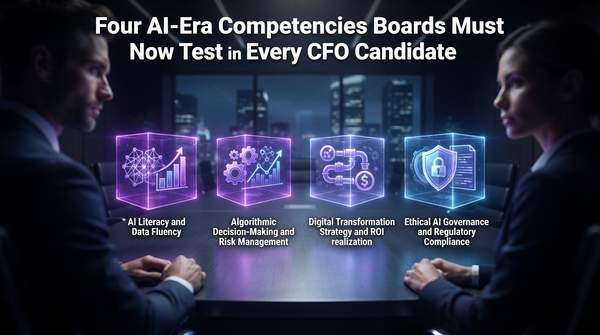
Four AI-Era Competencies Boards Must Now Test in Every CFO Candidate
Boards must update CFO succession planning to evaluate candidates on four critical AI-era competencies: AI and digital fluency, strategic AI investment, responsible AI governance, and transformational leadership. The CFO role is increasingly at risk of replacement due to AI, making proactive assessment essential.
Oct 24, 2026 · 6 min read

Vertical Aerospace Appoints Former Airbus Executive Marc Fontaine to Its Board
Vertical Aerospace has appointed former Airbus executive Marc Fontaine to its Board of Directors, a strategic move to enhance its expertise in digital transformation and aerospace programs as it advances certification for its Valo aircraft.
Oct 22, 2026 · 3 min read

Five Pillars of Trust: How C-Suite Leaders Can Diagnose and Rebuild Employee Confidence
A significant trust gap exists between C-suite leaders and employees regarding confidence in leadership. This article introduces a five-pillar diagnostic framework—Transparency, Reliability, Capability, Humanity, and Accountability—to help leaders identify and rebuild employee trust.
Oct 21, 2026 · 5 min read

AI as a Strategic Ally in Mid-Market Interim Management: A Four-Stage Framework
Mid-market companies need a structured AI strategy, not just scattered experiments. This article presents a four-stage framework for interim managers to strategically integrate AI, aligning it with business goals and ensuring successful implementation.
Oct 21, 2026 · 4 min read

Dedicated CDO, Integrated Lead, or Transitional Role: How Boards Should Structure Digital Leadership
Organizations must carefully consider their digital maturity and strategic priorities when structuring digital leadership. This article examines three key models: the Dedicated Chief Digital Officer, Integrated Digital Responsibilities, and the Transitional CDO, offering a framework for alignment.
Oct 20, 2026 · 5 min read

Before You Take the AI Recommendation: A Three-Part Judgment Test for the C-Suite
Executives must implement a three-part judgment test to evaluate AI recommendations for strategic decisions, ensuring decision readiness, accountability, and effective human-AI collaboration. This framework prioritizes human oversight and judgment over AI-driven automation.
Oct 20, 2026 · 6 min read

Five Due Diligence Areas Boards Must Probe Before Hiring a CISO
Hiring a CISO is a strategic leadership decision, not just a technical appointment. Boards must conduct thorough due diligence across five key areas to ensure a holistic fit for the evolving role.
Oct 18, 2026 · 6 min read

From Principles to Practice: A Phased Roadmap for Operationalizing AI Governance in the C-Suite
AI ethics charters often fail due to a lack of ownership and enforcement, rendering them mere values statements without an operational layer. Executives need a phased roadmap—foundation, integration, maturity—paired with clear accountability to truly operationalize AI governance.
Oct 18, 2026 · 6 min read

Federal Bank Appoints Cognizant Executive Rajesh Varrier as Independent Director
Federal Bank has appointed Rajesh Varrier, President of Global Operations at Cognizant, as a Non-Executive Independent Director to its board. The appointment, effective October 16, 2026, brings extensive technology and operational expertise to the bank, subject to shareholder approval.
Oct 18, 2026 · 4 min read

Four Pillars for Managing Third-Party Cyber Risk: A C-Suite Framework
Third-party cyber risk is an enterprise resilience challenge requiring a lifecycle-based framework, not just tactical checklists. This article presents a four-pillar model for C-suite leaders to audit and enhance their vendor risk management programs.
Oct 17, 2026 · 4 min read

Choosing Between Augmentation and Autonomy: A C-Suite Framework for Human-AI Collaboration
C-suite leaders must choose between AI augmentation and autonomous agents, a decision driven by organizational pressures and requiring clear governance. This framework helps executives diagnose these pressures to define the right human-AI collaboration model and strategic imperatives.
Oct 17, 2026 · 5 min read