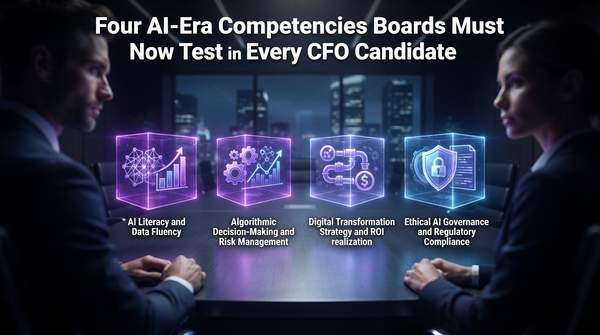
Boards planning a CFO succession can no longer rely on the traditional checklist of audit credibility, investor relations polish, and capital-markets fluency. Reporting on a June–July Boston Consulting Group survey indicates that nearly 60% of CEOs and chief operating officers plan to replace at least one C-suite member within six months, and that the CFO tops the list of positions at risk — driven, according to that reporting, by CEOs' desire to ensure their leadership teams can run a business in the age of AI. The practical implication for directors is concrete: succession candidates, internal or external, should be evaluated against four competencies — AI and digital fluency, strategic AI investment and resource allocation, responsible AI governance, and transformational leadership.
The Evolving CFO Role: Why Traditional Succession Planning Fails in the AI Era
The finance chief's mandate has widened faster than most succession pipelines have adapted. A 2026 Spencer Stuart roundtable on the CFO role in the age of AI, described by consultants Jean E. Chiswick, Sherry Ding, and Danny Koh, concluded that as AI becomes a business transformation priority, CFOs increasingly balance investment, risk, governance, and innovation while helping organizations capture value from AI. The role, in their framing, is expanding beyond financial stewardship into strategic resource allocation, responsible AI governance, and transformational leadership.
Alan Lester, writing in the Financial Executives Journal, argues that succession planning is now "essential to the successful development, deployment, and scaling of AI technologies" and central to business continuity — noting that major corporations such as Disney, Starbucks, and Tesla have faced well-publicized succession difficulties in recent years, and that AI has added another layer of complexity. Strong CFOs, the Spencer Stuart authors add, now collaborate with CIOs and CTOs on systems, data, infrastructure, and vendor selection, and work with boards and shareholders to align risk appetite and investment logic. Given how quickly the role is changing, they argue, companies must reevaluate how they develop and select future finance leaders.
AI and Digital Fluency: Navigating the Technological Landscape
The first competency is the most foundational: does the candidate genuinely understand AI's applications in finance, and its strategic implications? This involves more than basic digital literacy. It requires a working grasp of both AI's potential and its limitations — where machine-generated analysis can be trusted, and where human judgment must intervene.
The clearest assessment question comes from the Spencer Stuart analysis: has the candidate actively participated in or led innovation and business transformation initiatives involving AI? A controller who has automated close processes without ever engaging with the company's broader innovation agenda is not the same as a finance executive who has helped shape it. Boards should look for exposure to that broader agenda — candidates who can describe specific AI-enabled changes to finance workflows, not just express enthusiasm for technology.