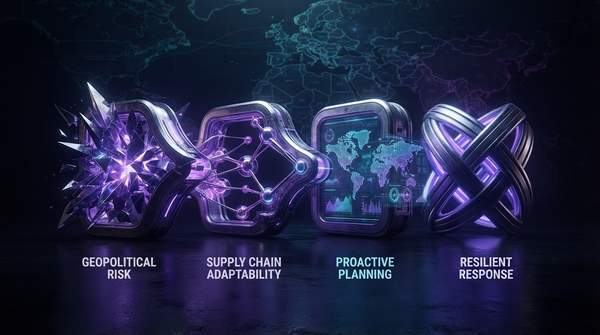
For most companies, geopolitical risk still arrives as a surprise: a tariff announcement, a sanction, a choke point closure, and the supply chain organization scrambles. The alternative is a structured scenario planning process that anticipates disruption before it lands. A study of multinational supply chains by researchers including Morris A. Cohen and Hau Lee's co-authors at MIT Sloan Management Review found that the conventional risk playbook is falling short against trade wars, sanctions, and armed conflict, and proposed a three-part response: understand geopolitical signals through scenario planning and risk monitoring, create flexible options in advance, and adapt quickly when disruption hits. This article turns that guidance into a four-step framework C-suite executives can implement.
The Imperative for Geopolitical Scenario Planning in Supply Chains
The case for scenario planning rests on a simple asymmetry: companies that model disruption before it occurs can evaluate response options calmly, while those that do not must improvise under pressure. The MIT Sloan researchers, who studied strategies supply chain managers at large companies actively use against tariffs, sanctions, and wars, concluded that regular scenario planning paired with continuous risk monitoring lets managers weigh trade-offs among strategies and react quickly to developments on the ground. Their sobering caveat deserves boardroom attention: what works today may prove inadequate tomorrow as political relationships shift and governments develop new tools of economic statecraft. Scenario planning is not prediction; it is structured preparation for a range of plausible futures.